
Decoding VARK Learning Styles: A Practical Guide
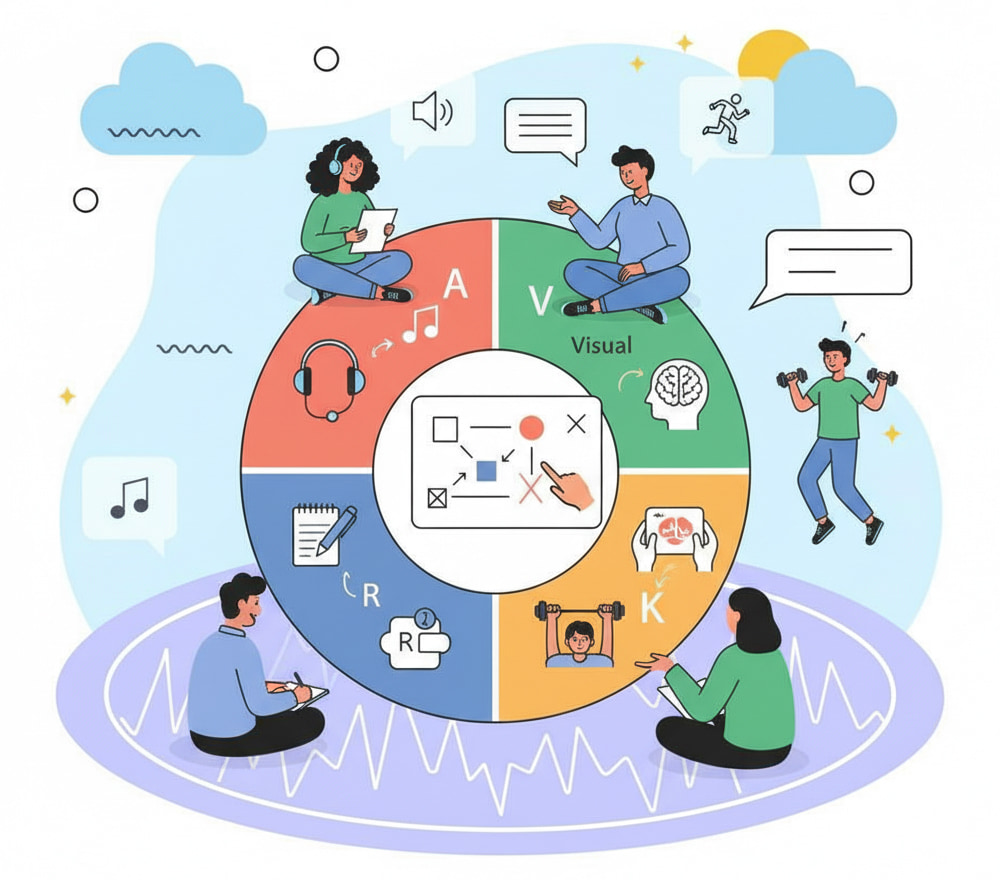
VARK Learning Style Assessment
Get StartedWhy VARK Still Matters in Modern Education
Across classrooms, training rooms, and self-directed study, learning success often hinges on how information is presented and processed. The VARK framework highlights preferences in perceiving and expressing knowledge, helping learners and instructors align materials with cognitive habits. Rather than boxing people into rigid categories, the approach encourages flexible, multimodal strategies that evolve with context. When used thoughtfully, it improves comprehension, speeds up recall, and makes study time more efficient.
Within this framework, VARK learning styles provide a plain-language way to discuss how people best absorb information through visual, aural, read/write, and kinesthetic channels. Developed to be practical rather than dogmatic, the method complements universal design for learning and evidence-based study techniques. In professional development settings, educators leverage preference data to design inclusive lessons that serve diverse cohorts. By combining analytics with reflection, people surface blind spots and discover new techniques that boost performance.
In research-informed teaching, many practitioners use the lens of VARK model learning styles to map activities to concrete outcomes, such as retention, problem-solving speed, and transfer of learning. Rather than relying on guesswork, they align slide design, discussion formats, handouts, and hands-on tasks with the audience’s dominant and secondary modes. Over time, this intentionality helps learners build a robust toolkit: sketching complex ideas, narrating processes aloud, annotating texts with purpose, and prototyping concepts through action.
Understanding the Four Modalities and How to Spot Them
The VARK acronym stands for four preferences: Visual, Aural (Auditory), Read/Write, and Kinesthetic. Each modality favors different cues, such as diagrams for visual thinkers or demonstrations for kinesthetic learners. Most people are multimodal, flexing across contexts, but identifying primary leanings can accelerate progress. Telltale signs include how someone takes notes, the kinds of questions they ask, and the study aids they naturally create without prompting.
In many classrooms, students ask for clarifying examples because they want concrete anchors for abstract material, and that curiosity is a useful signal. Educators who design varied entry points reduce cognitive friction while elevating engagement, and they make it easier for learners to switch modes on demand. Curated combinations, like a quick sketch paired with a narrated walkthrough, often produce durable understanding.
When introducing the framework in workshops, facilitators frequently field the question, what are the VARK learning styles, and they often reply with practical demonstrations rather than definitions. For instance, a short mind map and a brief role-play will convey the contrast more vividly than a slide of bullet points. That blend of experiences cements memory and empowers people to choose the right tool at the right time.
In diverse cohorts, a balanced mix of demonstrations, diagrams, and text is the simplest way to respect the breadth of VARK styles of learning without overfitting to a single preference. Teams that adopt this habit see improvements in collaboration because information becomes more transparent to different minds. Instructors who routinely “translate” a concept into multiple representations also model metacognition and adaptability.
| Modality | Typical cues | Useful tactics |
|---|---|---|
| Visual | Diagrams, color-coding, spatial layouts | Sketch flows, use icons, map relationships |
| Aural | Discussions, lectures, verbal explanations | Summarize aloud, teach a peer, record voice notes |
| Read/Write | Text, lists, definitions, dense notes | Outline concepts, annotate, create glossaries |
| Kinesthetic | Hands-on tasks, real examples, movement | Simulate steps, build prototypes, role-play scenarios |
Benefits and Real-World Payoffs for Learners and Educators
Adopting VARK-informed strategies can streamline how people study, teach, and collaborate. Learners who organize notes by modality often report sharper recall and calmer exam sessions. Teachers who weave in multiple representations, charts, dialogues, concise briefs, and labs, tend to get more inclusive participation and fewer “I’m lost” signals. Managers who train teams with a mix of visuals, talk-throughs, briefs, and practice drills see faster onboarding and fewer costly errors.
For self-directed learners, short diagnostics can illuminate blind spots, and that’s where a thoughtfully designed VARK learning styles quiz becomes a springboard for experimentation. Rather than treating the result as destiny, people use it to craft a more varied study plan and measure which tactics reliably move the needle. Over time, preferences can shift with task demands, so checking in periodically is wise.
In personal development, an adaptable approach helps professionals polish communication, and that includes noticing how a colleague prefers to receive information. Many people discover they can translate dense text into sketched summaries, or they can narrate a process to make it stick, which are habits tied to a flexible VARK learning style in practice. Ultimately, the benefit is agency: the ability to choose the method that fits the moment.
- Reduce friction by matching study aids to the task at hand.
- Increase retention by combining complementary modalities.
- Save time by skipping tactics that consistently underperform.
- Boost confidence by tracking which methods yield results.
How to Evaluate Preferences Without Getting Pigeonholed
Assessment works best when it leads to useful action, not labels. A good starting point is to collect a small baseline: note what you naturally do when learning a new concept, then test a different tactic and compare outcomes. Short reflections after study sessions can reveal patterns that numbers alone might miss, such as which representation gave you an “aha” moment and why it worked.
Many learners begin with a simple survey, and one popular format is a brief VARK learning styles questionnaire that surfaces tendencies across the four modalities. Others prefer a slimmer option, and some choose a targeted VARK learning style questionnaire to focus on specific study situations and practical adjustments. In both cases, responses should inform concrete next steps like altering note formats or rehearsal methods.
For more structured diagnostics, educators sometimes deploy a formal VARK learning styles assessment to analyze cohort patterns and refine course design. Teams in corporate training settings also benefit from a periodic VARK assessment of learning styles because it guides how to package SOPs, walkthroughs, and simulations for different roles. After gathering data, the real win comes from iterating on materials and measuring what changes improve outcomes.
- Track study inputs and results for two weeks to spot reliable tactics.
- Pair preference data with course objectives to avoid overfitting.
- Reassess after major projects to capture evolving needs.
Tactics and Study Routines That Leverage Modalities
Designing a week of study with variety keeps energy high and deepens encoding. Visual-heavy tasks might include sketchnotes, color-coded matrices, and simplified schematics; aural-heavy days could feature teach-back sessions and problem walkthroughs with a partner. When the content is text-dense, make a concise outline and transform definitions into your own words; when skills are procedural, build a miniature prototype or simulate the steps.
To consciously diversify, some learners schedule alternation blocks, and that rhythm prevents fatigue while fortifying memory traces. In project teams, labeling resources by their dominant mode helps colleagues “grab” the format that clicks fastest. In reflective logs, you can capture which representations made puzzling ideas suddenly obvious, then scale those patterns to future topics with similar complexity.
As you iterate, it can help to cross-check your evolving habits against the lens of learning styles VARK so you notice opportunities to expand your repertoire. After a sprint of practice, many students validate progress by taking a brief VARK learning style quiz to see whether new strategies are translating into tangible gains. The goal is not to pass a test, but to build a durable, flexible system that works across subjects.
- Visual: turn lectures into mind maps with arrows and clusters.
- Aural: record quick recaps and listen during commutes.
- Read/Write: convert complex diagrams into stepwise bullet summaries.
- Kinesthetic: perform micro-labs that model the core principle.
FAQ: Expert Answers About Using VARK Effectively
How accurate is a brief preference survey for guiding study choices?
Short surveys are a helpful starting point because they highlight tendencies, not absolutes. The real value appears when you use the results to design small experiments, such as trying a diagrammatic summary for one chapter and a narrated walkthrough for the next, then comparing retention. If the outcomes consistently favor one approach, double down on it while still practicing complementary modes to stay adaptable.
Is it possible to have strong preferences in more than one modality?
Yes, many people are multimodal, and their dominant preference can shift with task demands. For example, you might favor visual maps in systems thinking but rely on hands-on demos for technical workflows. Embrace this flexibility by building a menu of tactics and intentionally mixing them, which often improves transfer of learning and reduces boredom during long study sessions.
How should teachers apply VARK without oversimplifying?
Start by offering two or three representations for each core idea, then observe which formats trigger engagement. Use quick pulse checks, exit tickets, and reflective prompts to identify patterns, and update materials accordingly. You do not need four versions of everything, but you do want consistent variety across a unit, so learners can approach concepts from multiple angles and solidify understanding.
What’s the best way to combine modalities for tougher topics?
Layer modalities in a purposeful sequence: preview the concept with a concise visual, talk through the logic with a partner, condense key points into a short text summary, and cement it through a mini-application or simulation. This progression mirrors how the brain benefits from multiple retrieval routes, and it mitigates the weaknesses of any single format.
How often should I revisit my study plan as my skills grow?
Reevaluate every few weeks or after major milestones. Track which tactics are delivering results, then rotate in new methods to avoid plateaus. As the subject matter evolves, your optimal mix may change, so treat planning as an ongoing, data-informed practice rather than a one-time decision. Over time, the habit of adjustment becomes a competitive advantage in any learning environment.