
The Ultimate Guide to the VARK Model by Neil Fleming
VARK Learning Style Assessment
Get StartedWhat Is the VARK Model and Why Does It Matter
Across classrooms, boardrooms, and online courses, educators and facilitators often look for a simple way to describe how people prefer to absorb information. The VARK model offers a crisp, memorable framework built around four modalities: Visual, Aural, Read/Write, and Kinesthetic. Rather than claiming to measure ability, it gives a vocabulary for preference, making conversations about learning clearer and more actionable for everyone involved.
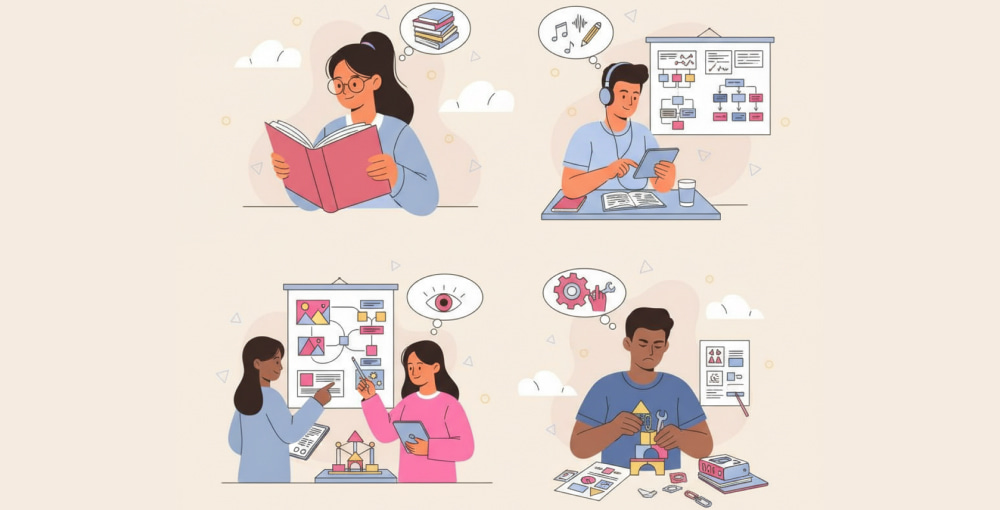
Visual preference highlights diagrams, charts, mind maps, and spatial layouts that reveal relationships at a glance. Aural preference centers on listening, discussion, and spoken explanations, where tone and rhythm enhance retention. Read/Write preference emphasizes text, lists, glossaries, and note-taking, leveraging the power of language and structure. Kinesthetic preference prioritizes movement, simulations, labs, demos, and real-world tasks that tether ideas to tangible experience.
Used judiciously, this framework can reduce friction between instructor intent and learner expectations. It encourages inclusive lesson design, nudges self-awareness, and supports better study planning. Most importantly, it complements evidence-based practices like spaced repetition, retrieval practice, and worked examples. When you combine modality-aware materials with proven cognitive techniques, you create learning environments that feel approachable yet rigorous, practical yet grounded in research-informed methods.
- Clarifies learner preferences without labeling ability
- Guides balanced lesson planning and resource selection
- Boosts engagement through multimodal presentation
- Pairs effectively with cognitive science techniques
- Supports reflective study habits and metacognition
Origins and Foundations of the Framework
The roots of the model trace to practical observation and iterative refinement. Rather than emerging from a single laboratory experiment, the idea grew through sustained interaction with teachers, students, and trainers who needed a flexible language to discuss how materials land with different audiences. Over time, common patterns solidified around the four modalities, giving instructors a scaffold for planning and reflection.
The framework, often referenced as Neil Fleming VARK, consolidated classroom observations into a practical typology for everyday teaching. Its ongoing appeal comes from usability: a short questionnaire, plain-English categories, and straightforward recommendations. That blend of simplicity and immediate applicability helped the approach spread globally, especially among practitioners seeking quick wins that do not demand heavy technology or large budgets.
Critically, the model does not claim to predict achievement; it focuses on preference. This distinction matters because it shifts conversations away from fixed traits and toward adaptable strategies. Instructors can map lessons to multiple modalities, and learners can cultivate versatility by mixing study tools. The result is a shared, nonjudgmental language that supports experimentation, reflection, and continuous improvement across contexts.
Core Benefits for Learners, Teachers, and Teams
When used thoughtfully, modality awareness yields practical, measurable benefits. For students, it reveals which study tactics feel natural and which require deliberate practice. For teachers and instructional designers, it offers a lens to audit materials, ensuring that diagrams, discussions, explanations, and hands-on tasks each have a seat at the table. For teams, it creates a common vocabulary that reduces miscommunication in training and onboarding.
In professional development, the original taxonomy, credited to VARK Neil Fleming, gives managers a neutral language to discuss learning preferences without stereotyping. By encouraging a mix of talking, reading, visualizing, and doing, workshops become more inclusive and memorable. This mixture not only boosts participation but also aligns with how complex skills are actually acquired: through repeated exposure, varied practice, and timely feedback.
Benefits manifest in several ways. Engagement rises because people encounter information in multiple forms. Retention improves when content is revisited through different channels, strengthening memory traces. Confidence grows as learners recognize a menu of options to use before high-stakes moments such as exams, presentations, or client meetings. Over time, teams develop a culture of flexible delivery and adaptable study, which pays dividends in performance and morale.
- Faster comprehension through matched explanations
- Reduced cognitive overload via multimodal sequencing
- Better collaboration stemming from shared terminology
- Improved transfer of learning to real tasks and decisions
- Higher satisfaction scores in courses and training programs
Modalities and Practical Strategies You Can Use Today
Turning principles into action requires concrete tactics. A Visual approach might include layered diagrams, timelines, and color-coded frameworks that show structure. An Aural approach could feature brief lectures, structured debates, and voice notes that capture nuance. A Read/Write approach thrives on concise summaries, annotated readings, and disciplined note-taking systems. A Kinesthetic approach leans on labs, role-plays, field observations, prototyping, and task rehearsals that embody the concept.
To make planning easier, the following table distills the four modalities into quick-start strategies. Use it to audit lessons, select study tools, or design blended training that respects preference while broadening skill.
| Modality | Signature Cues | Quick Strategies | Assessment Ideas |
|---|---|---|---|
| Visual | Diagrams, spatial maps, icons | Flowcharts, infographics, sketchnotes | Label a process map; redraw a system |
| Aural | Talk-throughs, tone, rhythm | Podcasts, Socratic questions, summaries aloud | Record a verbal explainer; peer debrief |
| Read/Write | Lists, glossaries, dense text | Outlines, Cornell notes, one-pagers | Create a concise guide; compare definitions |
| Kinesthetic | Movement, touch, real context | Simulations, demos, checklists in action | Run a scenario; build and test a prototype |
Mixing modalities prevents tunnel vision and strengthens understanding. For example, you might introduce a concept with a diagram, reinforce it through discussion, consolidate it with a written brief, and cement it via a hands-on exercise. That sequence respects preference while harnessing the desirable difficulty that deepens learning. In self-study, rotate tools: mind map an article, talk through a summary, condense notes into a checklist, then apply the idea in a small project. Consistent, multimodal cycles build durable knowledge.
Assessment, Evidence, and Ethical Use
Questionnaires associated with the model are best treated as conversation starters. They highlight tendencies, not destinies. When learners treat results as flexible guides, they’re more willing to experiment across modalities and pair preferences with proven methods like retrieval practice and spaced intervals. Educators, meanwhile, can use results to balance materials without pigeonholing students or overfitting lessons to a single channel.
Within research debates, the appellation VARK Fleming occasionally appears when scholars map citations across decades. While arguments continue around labeling and effect sizes, a practical middle path has emerged among experienced instructors: teach with varied representations, encourage metacognition, and measure outcomes with clear rubrics. When the focus remains on transfer, clarity, and performance, modality awareness functions as a helpful design lens rather than a rigid classification system.
Ethically, avoid implying that preference equals potential. Offer options, encourage cross-training between modalities, and collect feedback about what truly aids comprehension. Transparency also matters: explain why you’re using a mix of diagrams, talk-throughs, readings, and activities. By anchoring decisions in learner outcomes and sound pedagogy, you preserve the strengths of the framework while aligning practice with contemporary learning science.
FAQ: Common Questions About the VARK Approach
Does the model measure intelligence or ability?
No. It highlights preference, which can guide study habits and lesson design, but it does not predict performance or capacity. Pairing preferred modalities with evidence-based strategies remains the most reliable path to improvement.
How should teachers integrate the four modalities in one lesson?
Plan a sequence: visualize the big picture, discuss the key moves, provide a concise reading or checklist, and finish with a hands-on activity. Short, purposeful transitions keep momentum while serving multiple preferences.
Can learners effectively study outside their preferred modality?
Yes. In fact, mixing modalities often enhances retention. Many students start with a comfort zone and then expand it by rotating tools like diagrams, summaries, voice notes, and practice tasks.
Is a questionnaire required to use the framework?
Not necessarily. You can observe which materials resonate and invite learners to reflect on what helps them remember and apply ideas. A survey can still be useful for quicker self-awareness and a common language.
What pitfalls should organizations avoid when adopting the model?
Avoid pigeonholing staff, over-customizing for one channel, or neglecting practice and feedback. Use modality awareness to diversify delivery while keeping assessments aligned with real performance goals.