
VARK Model Explained: A Guide to Designing Instruction That Resonates
VARK Learning Style Assessment
Get StartedWhat VARK Is and Why It Matters for Teaching and Training
Educators and coaches often seek a clear way to discuss differences in how people absorb information. In that conversation, the VARK model frequently serves as a practical shorthand for preferences across visual, aural, read/write, and kinesthetic modalities. Rather than promising a miracle formula, this framework gives facilitators an accessible language for planning lessons, calibrating materials, and inviting learners to self-advocate. It shines when used as a guide for variety and as a prompt for reflection, not as a rigid label.
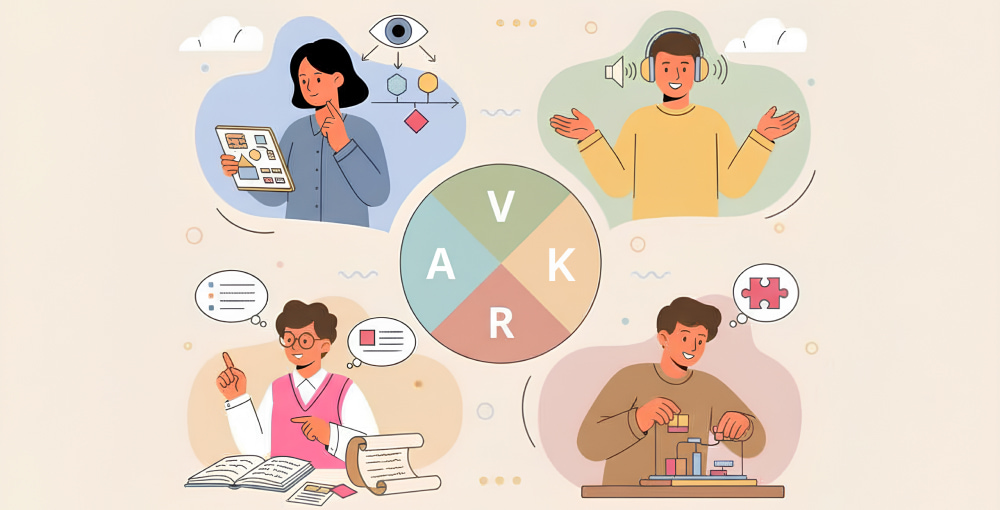
The acronym points toward four distinct but overlapping channels of input. Some participants gravitate to diagrams, others to listening, many to text, and plenty to movement or hands-on experimentation. Real classrooms and workshops contain blends of these tendencies, which means thoughtful design rarely relies on a single medium. By layering visuals, conversation, concise handouts, and tactile practice, instructors expand entry points and reduce friction for everyone, including neurodiverse learners and multilingual audiences.
- Offer choices in how learners engage with core concepts.
- Sequence activities to cycle through multiple modalities.
- Invite metacognitive check-ins so learners notice what helps them succeed.
- Collect feedback and iterate, emphasizing continuous improvement over dogma.
The Four Modalities and How to Recognize Them in Real Settings
Across grade levels and professional programs, you’ll see recurring patterns in how people connect with content. Within classrooms and training rooms, the VARK model learning styles label helps people name tendencies without pathologizing differences. Visual-oriented participants scan for structure and spatial relationships; aural-leaning learners tune into rhythm, tone, and dialogue; text-focused individuals savor crisp prose and tidy notes; and kinetic explorers learn by doing, manipulating tools, and testing boundaries. These preferences can change with context, fatigue, or task complexity, so flexibility remains essential.
As you observe, look for cues such as the questions learners ask, the artifacts they create, and the strategies they spontaneously choose. Some will sketch mind maps before speaking; others prefer reading a brief and summarizing aloud. A handful will stand up to think more clearly, while many will jot bullet points to stabilize memory. The goal is not to pigeonhole anyone but to provide multiple doorways into the same knowledge and to normalize cross-training across modalities.
| Modality | Telltale cues | Helpful tactics | Common pitfalls |
|---|---|---|---|
| Visual | Asks for diagrams, color-coding, and spatial overviews | Concept maps, annotated slides, timelines, and process flows | Overcrowded visuals, inconsistent icons, tiny fonts |
| Aural | Thrives in discussion, remembers tone and phrasing | Podcasts, debates, read-alouds, think-pair-share | Monologues without interaction, noisy rooms |
| Read/Write | Requests handouts, prefers manuals and succinct text | Checklists, summaries, glossaries, structured note-taking | Walls of text without hierarchy, vague instructions |
| Kinesthetic | Wants to handle equipment, builds prototypes, role-plays | Simulations, labs, fieldwork, manipulatives | Abstract talk without practice, unsafe or aimless activities |
Use the table above to quickly align your delivery with observable needs, then mix modalities so each learner receives multiple paths to mastery. The richest sessions feel dynamic: sketch a process, narrate the why, offer a concise brief, then orchestrate a short lab to cement transfer.
Benefits, Personalization, and Equitable Design
Thoughtful facilitators leverage preference-aware planning to remove barriers and build momentum. When used humbly, the VARK model of learning becomes a springboard for inclusive design rather than a pigeonhole. The emphasis shifts from labeling people to expanding access, which improves outcomes for novices and experts alike. Learners gain agency because they can articulate what helps them focus, while instructors gain clarity about scaffolding and sequence.
The advantages compound across a course. Early activities that surface preferences prime trust, letting participants experiment with different study strategies before stakes rise. Transparent alignment between goals, materials, and assessments reduces cognitive load and confusion. Small adjustments, like adding a one-page summary, narrating key diagrams, or integrating a brief hands-on segment, often yield disproportionate gains.
- Increases engagement by aligning inputs with attention patterns.
- Improves retention through multimodal encoding and retrieval practice.
- Supports accessibility, especially when paired with universal design principles.
- Encourages reflective practice and self-regulation among learners.
- Enables instructors to diversify assessment without diluting rigor.
Workplace, Professional Development, and Measurable Impact
Training leads in organizations face the twin mandate of speed and quality. Across corporate academies and apprenticeship programs, the VARK learning model encourages diversified delivery and measurement. Onboarding flows that blend visual dashboards, live briefings, concise job aids, and hands-on shadowing shorten ramp time and reduce errors. Sales enablement, safety instruction, and leadership development all benefit from multisensory design that respects adult constraints.
To translate this approach into performance, map each critical skill to at least two complementary activities. For example, introduce a procedure with a schematic and a story-driven walkthrough, then reinforce with a quick-reference sheet and a supervised trial. Capture analytics on participation, proficiency, and transfer, and use that data to tune the mix in subsequent cohorts. When leaders see fewer help-desk tickets and faster time to competency, adoption spreads organically.
- Pair visual SOPs with short verbal debriefs after each shift.
- Convert dense manuals into layered summaries with hyperlinks and checklists.
- Stage micro-simulations that let teams practice under realistic constraints.
- Close with targeted reflections to consolidate learning and plan application.
Research, Critiques, and Evidence-Based Practice
Scientists and practitioners have debated preference frameworks for decades, especially when claims drift toward prediction. Against that backdrop, the VARK learning style model should be treated as a preference map, not a fixed trait or predictor of achievement. The strongest evidence favors multimodal instruction, retrieval practice, spaced repetition, and feedback loops. These pillars integrate smoothly with preference-aware planning without overpromising personalized magic.
Misuse happens when labels harden into identities or when teaching becomes a one-note exercise in matching. A healthier stance pairs curiosity with pragmatism: identify tendencies, diversify inputs, and test what works for this content and this group right now. Keep expectations realistic, document results, and remain open to contrary data. When teams continuously test and adapt, the approach evolves from ideology into disciplined craft.
- Use preferences to inform variety, not to restrict exposure.
- Blend modalities with proven learning science practices.
- Measure outcomes and iterate based on real performance data.
- Educate learners about metacognition and study strategy selection.
FAQ: Common Questions About VARK in Practice
Is this framework only for schools?
No. It translates well to corporate training, healthcare education, military instruction, and community workshops. Anywhere people need to acquire skills or make sense of new information, a modality-aware approach can clarify planning and reduce friction.
Will matching instruction to a single preference boost results dramatically?
Not reliably. The biggest gains come from varied inputs, practice opportunities, and feedback. Treat preferences as a guide for inclusion, then combine them with evidence-based strategies like retrieval, spacing, and interleaving.
How do I start without rebuilding my entire course?
Audit a single unit. Add one diagram, one short discussion prompt, one page of distilled text, and one brief hands-on activity. Collect feedback, compare outcomes, and scale the adjustments that deliver value.
What about online learning environments?
Digital platforms offer rich opportunities: interactive visuals, breakout audio dialogues, downloadable summaries, and virtual labs. Balance production effort with impact by focusing on clarity, accessibility, and opportunities for application.
How do I avoid stereotyping learners?
Use language that emphasizes fluidity and context. Invite people to experiment with multiple strategies and to choose what fits the task at hand. Reinforce the message that preferences inform design, but skills grow through practice across modalities.